






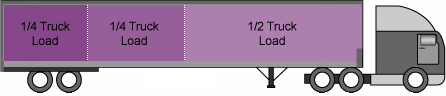
LTL Trucking (less-than-truckload) shipments typically weigh between 100 and 20,000 lbs and range from a single pallet to several pallets that don’t require a full 48′ or 53′ trailer. Since it would be expensive and inefficient to move small shipments alone, LTL trucking consolidates multiple shippers’ freight onto one trailer so each customer only pays for the space and weight their shipment actually uses.
 Great Western Transportation offers a number of services not typically available from other carriers, including lift gate service, sorting and segregating, de-vanning of containerized goods, palletizing and shrink wrapping, storage, distribution, re-delivery services, and warehousing. Our Dry LTL, Refrigerated LTL, and Flatbed LTL services extend throughout the Continental United States and Canada.
What Is LTL Trucking?
LTL freight is priced and handled differently from a full truckload because it shares trailer space with other shippers’ freight. Two factors determine how a shipment is priced and processed:
- Freight class: Every LTL shipment is assigned a freight class under the National Motor Freight Classification (NMFC) system, ranging from class 50 (least expensive, dense freight like steel) to class 500 (most expensive, low-density freight like empty containers or foam products). Class is based on the shipment’s density, stowability, handling, and liability.
- Dimensional weight: For bulky, low-density freight, carriers calculate dimensional (dim) weight using length x width x height (in cubic inches) divided by 194. Whichever is greater, actual weight or dimensional weight, is what the shipment is billed on. Shipments should be weighed and measured accurately before pickup — if the reported weight is off, the carrier can re-weigh the freight and adjust the invoice, which can also delay delivery.
LTL Trucking vs. Full Truckload and Parcel
Choosing the right shipping method comes down to a few practical questions:
- LTL vs. full truckload (FTL): FTL is generally the lower-cost option per pound when a shipment can fill a trailer, but most shippers don’t have enough volume moving to a single destination to justify a dedicated truck on every load. LTL lets you ship smaller, more frequent quantities without paying for unused trailer space.
- LTL vs. parcel: The traditional rule of thumb was that freight over 150 lbs moved LTL while lighter packages moved parcel, but that line has blurred as parcel carriers have expanded into heavier freight. The more useful questions are: Is the freight palletized and better suited to forklift handling than a conveyor belt? Can you consolidate multiple packages into one shipment rather than sending them individually? And does the delivery location have loading-dock access, since LTL carriers generally prefer dock-to-dock delivery while parcel carriers offer more flexible door-to-door service?
- Transit time: Parcel carriers can usually guarantee delivery by a specific day. LTL delivery typically arrives within a 1-2 day window unless the shipment is expedited.
Packaging and Freight Protection for LTL Shipments
Because LTL freight is handled multiple times as it moves through a carrier’s network, packaging matters more than it does for a single dedicated truckload. A few guidelines by freight type:
- Cartons: Stack using the column or interlocking (pinwheel) method and reinforce with stretch wrap.
- Crates: Build with quality lumber, diagonal braces, and proper corner fasteners.
- Bags: Use the interlocking stack method with a solid bottom cushion, and fasten securely to the pallet.
- Spools and reels: Anchor securely to a fork-lift-ready pallet.
- Drums: Strap, protect, and support with a solid pallet base if palletized.
- Pipes and long freight: Bundle, secure, and crate to prevent shifting.
- Tires: Band and shrink-wrap to the pallet, with an anti-skid surface for tall stacks.
Tamper-evident seals, king pin locks, door locks, and GPS trailer tracking are additional options worth considering for high-value or sensitive freight moving through multiple handling points.
Commonly Shipped LTL Freight
- Automotive parts and accessories
- Computers, laptops, and electronics
- Consumer goods
- Electronic coils, transformers, and related devices
- Heavy industrial equipment and supplies
- Perfumes, cosmetics, and other preparations
- Manufacturing equipment and supplies
- Paper and plastics
- Pharmaceutical products
- Telecommunications products
- Wholesale industrial machinery and equipment
Volume Pricing and Accessorial Charges
Shipments exceeding roughly 8,000 lbs and/or 8 pallets are generally treated as volume shipments, and Great Western Transportation can offer discounted rates at that threshold. Beyond the base rate, LTL carriers may charge accessorial fees for services outside standard pickup and delivery — common examples include lift gate service, inside delivery, collect-on-delivery (COD) handling, residential delivery, and arrival notification. Knowing which accessorials your shipment needs before it ships helps avoid surprise charges on the invoice.
How Great Western Coordinates Your LTL Shipment
Each Great Western customer works with a dedicated freight consultant who coordinates the shipment from pickup through delivery and can provide an updated ETA at any point. For time-critical freight, we offer expedited LTL service, including team-driver options, to meet tighter delivery windows. Our team is experienced in handling high-value and delicate LTL freight that requires extra care in transit, and we offer LTL consolidation services for shippers who want to combine multiple smaller shipments. Great Western moves LTL freight anywhere in the continental United States and into Canada — whether the lane is 500 miles or 5,000.
Don’t Forget We Also Handle Full Truckload Shipments!
Let us prove to you that Great Western Transportation is your Premier Trucking Service.
Call us for information about our trucking services or for a rate quote.
Great Western Transportation 5000 Pleasanton Ave, Suite 145 Pleasanton, CA 94566